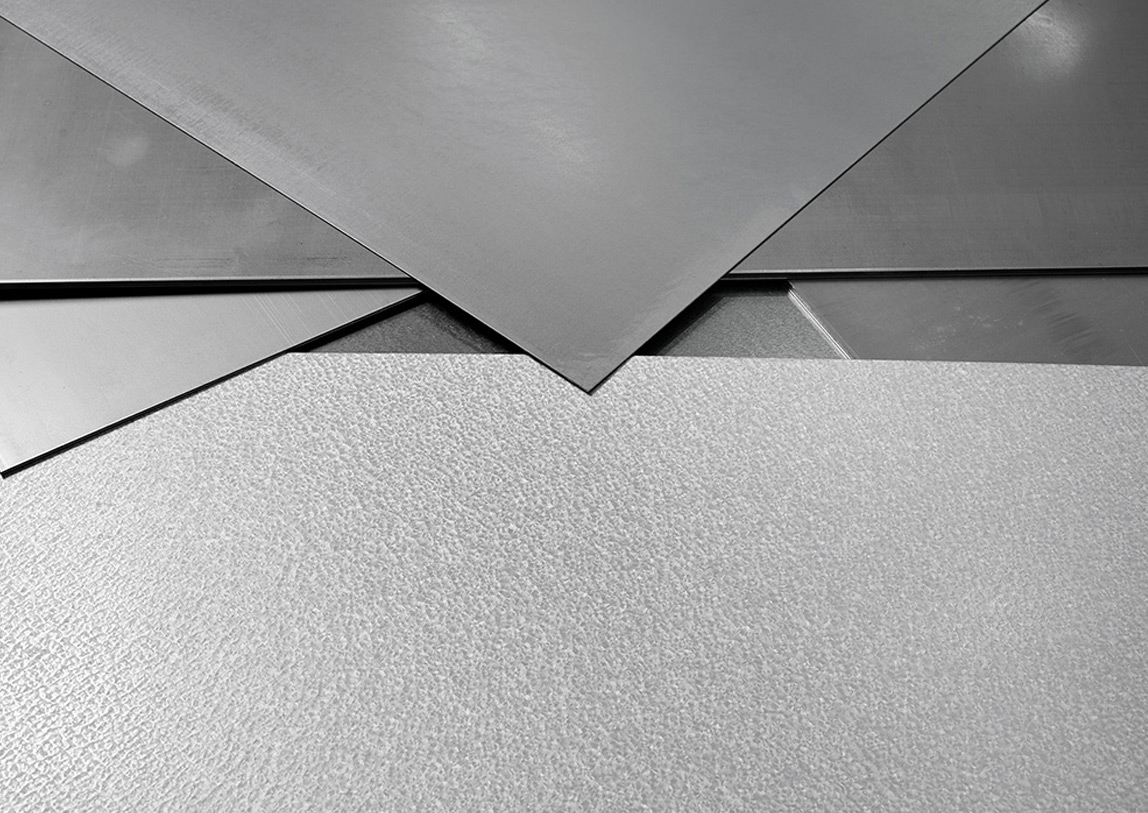
Material types
Cold-Rolled Steel
MANUFACTURING PROCESS
Cold rolling is based on hot-rolled, pickled coils. The coil is passed through a series of roll stands, where its thickness is reduced in the cold state. The material is then annealed and skin-passed to achieve the desired mechanical properties. Cold-rolled steel is manufactured in thicknesses ranging from approximately 0,30 to 3,00 mm.
Steel grades
Mild steels:
Used when forming and stamping properties are more important than strength properties.
Available in grades from DC01 to DC06.
High-strength steel:
Offers good potential for weight reduction.
Micro-alloyed steel:
Combines high strength and good formability. Its consistent strength properties make it
well suited for bending and flanging, as well as simpler pressing operations.
Dual-Phase Steel:
Dual-phase steel (DP) combines good formability with high strength. It
provides both work-hardening and bake-hardening properties, meaning that its yield strength
increases during bending or pressing and through certain types of paint-curing processes.
Rephosphorized Steel:
Rephosphorized steel is a phosphorus-alloyed (P) high-strength steel characterized by
excellent deep-drawing properties. During press forming, the material undergoes strain
hardening, resulting in increased strength as it is shaped. Consequently, the finished
component can achieve higher strength than the original, unformed material.
Mechanical properties – mild steel
| EN 10130:2006 | Yield strength Re (N/mm²) |
Tensile strength Rm (N/mm²) |
Elongation % A80 min. (%) |
r90 min. | n90 min |
|---|---|---|---|---|---|
| DC01 | 140-280 | 270-410 | 28 | – | – |
| DC03 | 140-240 | 270-370 | 34 | 1,3 | – |
| DC04 | 140-210 | 270-350 | 38 | 1,6 | 0,18 |
| DC05 | 140-180 | 270-330 | 40 | 1,9 | 0,20 |
| DC06 | 120-170 | 270-330 | 41 | 2,1 | 0,22 |
Values are based on samples taken across the rolling direction.
Mechanical properties – high-strength micro-alloyed steel
| EN 10268:2006 | Yield strength Re (N/mm²) |
Tensile strength Rm (N/mm²) |
Elongation A80 min. (%) |
Bend diameter for 180° bend |
|---|---|---|---|---|
| HC260LA | 260-330 | 350-430 | 26 | 0 x t |
| HC300LA | 300-380 | 380-480 | 23 | 0 x t |
| HC340LA | 340-420 | 410-510 | 21 | 0 x t |
| HC380LA | 380-480 | 440-580 | 19 | 0,5 x t |
| HC420LA | 420-520 | 470-600 | 17 | 0,5 x t |
Values are based on samples taken across the rolling direction.
Surface
For cold-rolled steel there are two surface quality classes, as well as a classification of surface roughness.
Surface quality according to EN 10130:2006
| Surface quality A | Minor defects such as pores, small scratches and slight discolouration are permitted. Surface quality A is the most common and suits most applications. |
| Surface quality B | One side must be free from defects that could affect the appearance of a quality-painted surface. The other side must at least meet the requirements for surface quality A. |
Surface appearance according to EN 10130:2006
| Finish | Symbol | Surface roughness |
|---|---|---|
| Bright | b | Ra ≤ 0,4 μm |
| Semi-bright | g | Ra ≤ 0,9 μm |
| Normal | m | 0,6 μm < Ra ≤ 1,9 μm |
| Rough | r | Ra > 1,6 μm |
Our standard is surface quality A, surface appearance m, and a lightly oiled surface.
Thickness tolerances
Thickness tolerances, according to EN 10131:2006 (for steel grades with a specified min. yield strength of <260 MPa)
| Nominal thickness (mm) | Thickness tolerances for nominal width (mm) | ||
|---|---|---|---|
| ≤ 1200 | > 1200 ≤ 1500 | > 1500 | |
| > 0,35 ≤ 0,40 | ± 0,03 | ± 0,04 | ± 0,05 |
| > 0,40 ≤ 0,60 | ± 0,03 | ± 0,04 | ± 0,05 |
| > 0,60 ≤ 0,80 | ± 0,04 | ± 0,05 | ± 0,06 |
| > 0,80 ≤ 1,00 | ± 0,05 | ± 0,06 | ± 0,07 |
| > 1,00 ≤ 1,20 | ± 0,06 | ± 0,07 | ± 0,08 |
| > 1,20 ≤ 1,60 | ± 0,08 | ± 0,09 | ± 0,10 |
| > 1,60 ≤ 2,00 | ± 0,10 | ± 0,11 | ± 0,12 |
| > 2,00 ≤ 2,50 | ± 0,12 | ± 0,13 | ± 0,14 |
| > 2,50 ≤ 3,00 | ± 0,15 | ± 0,15 | ± 0,16 |
For yield strength ≥ 260 to < 340 N/mm² the thickness tolerances are increased by approx. 20%.
For yield strength ≥ 340 to ≤ 420 N/mm² the thickness tolerances are increased by approx. 40%.
Tighter tolerances available at an additional cost.
Width tolerances
Width tolerances, according to EN 10131:2006
| Nominal width w |
Normal tolerances (mm) | |
|---|---|---|
| Under | Over | |
| w ≤ 1200 | 0 | +4 |
| 1200 < w ≤ 1500 | 0 | +5 |
| w > 1500 | 0 | +6 |
Wide range of materials
We offer a wide range of material grades, including hot-rolled, cold-rolled, hot-dip galvanized, Aluzinc, zinc-magnesium, electro-galvanized, Corrender, and coated materials. Material samples and test certificates can also be provided to document both mechanical and chemical properties.