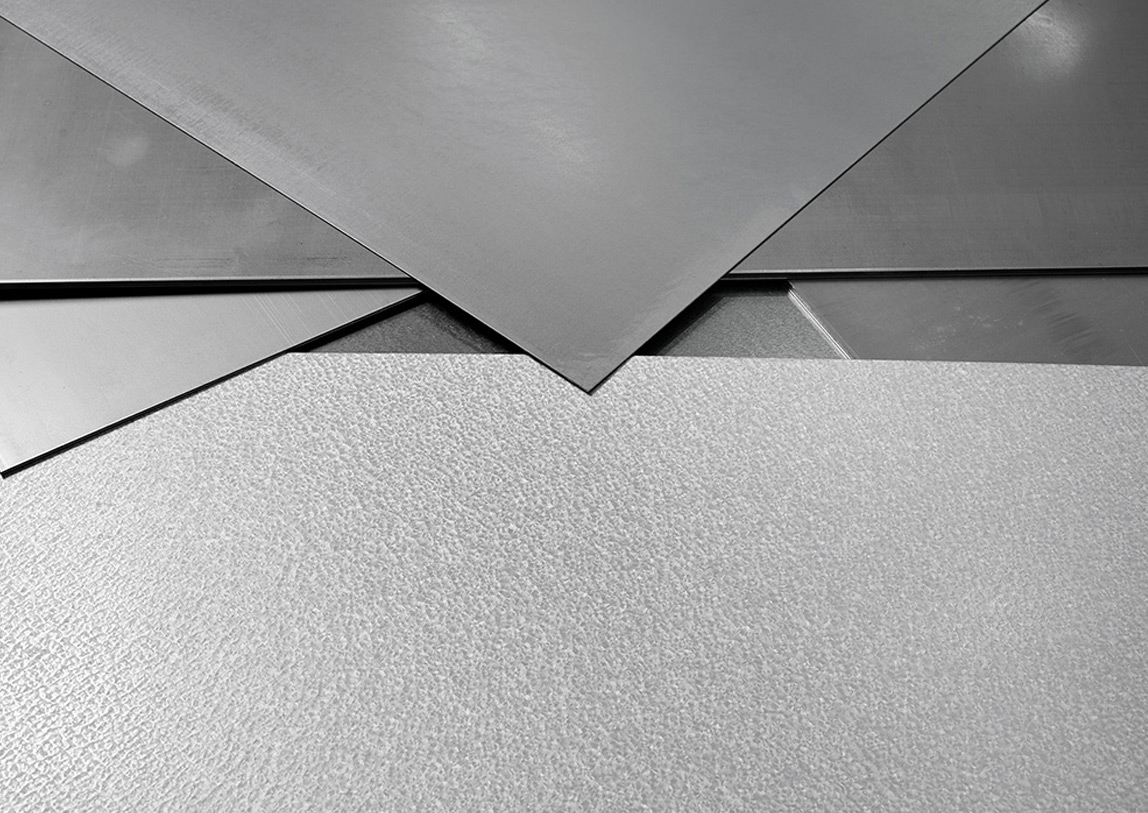
Material types
Hot-Dip Galvanized Steel

MANUFACTURING PROCESS
Hot-dip galvanized sheet is based on either cold-rolled or hot-rolled sheet, which is first cleaned by
degreasing and also pickling before galvanizing. The coil then passes through a zinc bath where
the amount of zinc can be controlled to the desired level. After galvanizing, the material is cooled down and checked.
Hot-dip galvanized sheet can be manufactured in thicknesses from about 0,35 mm up to about 6,0 mm.
Steel grades
Mild steel:
Used when forming and pressing properties are more important than strength properties.
Available in grades DX51D to DX56D.
Structural steel:
Mainly used in the construction industry and suitable for roll forming and simple bending. Has
guaranteed minimum values for yield strength and tensile strength.
High-strength steel:
Offers good potential for weight savings.
Micro-alloyed steel:
Combines high strength with good formability. It has consistent strength properties
and is intended for simpler pressing and forming operations.
Dual-Phase Steel (DP):
Dual-phase steel (DP) combines good formability with high strength. The material exhibits
both strain-hardening and bake-hardening properties, meaning that its yield strength increases
during bending or press forming, as well as during certain paint-curing processes.
Rephosphorized Steel:
Phosphorus-alloyed (P) high-strength steel with good stretch-forming properties.
The final strength of the finished part is achieved through work hardening during pressing.
Mechanical properties – mild steel
| EN 10346:2015 | Yield strength Re (N/mm²) |
Tensile strength Rm (N/mm²) |
Elongation A80 min. (%)* |
|---|---|---|---|
| DX51D | Min. 140 | 270-500 | 22 |
| DX52D | 140-300 | 270-420 | 26 |
| DX53D | 140-260 | 270-380 | 30 |
| DX54D | 120-220 | 260-350 | 36 |
| DX56D | 120-180 | 260-350 | 39 |
Values are based on samples taken across the rolling direction.
*) For t ≤ 0,70 mm a value two units lower applies.
Mechanical properties – structural steel
| EN 10346:2015 | Yield strength Re min. (N/mm²) |
Tensile strength Rm min. (N/mm²) |
Elongation A80 min. (%)* |
|---|---|---|---|
| S220GD | 220 | 300 | 20 |
| S250GD | 250 | 330 | 19 |
| S280GD | 280 | 360 | 18 |
| S320GD | 320 | 390 | 17 |
| S350GD | 350 | 420 | 16 |
| S550GD | 550 | 560 | – |
Values are based on samples taken along the rolling direction.
*) For t ≤ 0,70 mm a value two units lower applies.
Mechanical properties – high-strength micro-alloyed steel
| EN 10346:2015 | Yield strength Re (N/mm²) |
Tensile strength Rm (N/mm²) |
Elongation A80 min. (%)* |
|---|---|---|---|
| HX260LAD | 260-330 | 350-430 | 26 |
| HX300LAD | 300-380 | 380-480 | 23 |
| HX340LAD | 340-420 | 410-510 | 21 |
| HX380LAD | 380-480 | 440-560 | 19 |
| HX420LAD | 420-520 | 470-590 | 17 |
Values are based on samples taken across the rolling direction.
Surface coating
The amount of zinc on the sheet is specified in weight classes, of which Z275 is one of the most common. The number 275 refers to the combined weight of the zinc coating in g/m² on both sides of the sheet, based on a so-called triple-spot test. A single-spot test allows a slightly lower coating weight.
Surface coating
| Weight class | Zinc weight, incl. both sides (g/m2) | Zinc coating thickness per side* (µm) |
|
|---|---|---|---|
| Triple-spot test min. | Single-spot test min. | ||
| Z100 | 100 | 85 | 7 |
| Z140 | 140 | 120 | 10 |
| Z200 | 200 | 170 | 14 |
| Z275 | 275 | 235 | 20 |
| Z350 | 350 | 300 | 25 |
*) The zinc coating thickness is calculated based on the minimum values for the triple-spot test (1 µm = 7,14 g/m2)
Surface
Surface appearance
| N | Normal spangle pattern (rarely used nowadays) |
| M | Minimised spangle pattern (has become standard) |
Surface quality
| A (Normal surface) | Minor pores, variations in the spangle pattern, dark spots, streaks and small passivation marks are permitted. Stretcher-strain marks and zinc run-off marks may occur. |
| B (Improved surface) | Skin-passed material. Minor defects such as stretcher-strain marks, skin-pass marks, scratches, indentations, spangle pattern, zinc run-off marks and faint passivation marks may occur. The surface is free from pores. |
| C (Best surface) | Skin-passed material. One side must be free from defects that could affect the appearance of a first-class painted surface. The other side must at least meet the requirements for surface quality B. |
Surface treatment
| C | Chemical passivation |
| O | Oiling |
| CO | Chemical passivation + oiling |
Our standard is surface M A C, and it meets the requirements of the RoHS directive.
Thickness tolerances
Thickness tolerances, according to EN 10143:2006 (for steel with a specified min. yield strength <260)
| Nominal thickness (mm) | Thickness tolerances for nominal width (mm) | ||
|---|---|---|---|
| ≤ 1200 | > 1200 ≤ 1500 | > 1500 | |
| ≥ 0,35 ≤ 0,40 | ± 0,04 | ± 0,05 | – |
| > 0,40 ≤ 0,60 | ± 0,04 | ± 0,05 | ± 0,06 |
| > 0,60 ≤ 0,80 | ± 0,05 | ± 0,06 | ± 0,07 |
| > 0,80 ≤ 1,00 | ± 0,06 | ± 0,07 | ± 0,08 |
| > 1,00 ≤ 1,20 | ± 0,07 | ± 0,08 | ± 0,09 |
| > 1,20 ≤ 1,60 | ± 0,10 | ± 0,11 | ± 0,12 |
| > 1,60 ≤ 2,00 | ± 0,12 | ± 0,13 | ± 0,14 |
| > 2,00 ≤ 2,50 | ± 0,14 | ± 0,15 | ± 0,16 |
| > 2,50 ≤ 3,00 | ± 0,17 | ± 0,17 | ± 0,18 |
| > 3,0 ≤ 5,00 | ± 0,20 | ± 0,20 | ± 0,21 |
For yield strength ≥ 260 to < 360 N/mm² tolerances are increased by 15 – 20%.
For yield strength ≥ 360 to < 420 N/mm² tolerances are increased by 30 – 40%.
Tighter tolerances available at an additional cost.
Width tolerances
Width tolerances, according to EN 10143:2006
| Nominal width w |
Normal tolerances (mm) | |
|---|---|---|
| Under | Over | |
| w ≤ 1200 | 0 | +5 |
| 1200 < w ≤ 1500 | 0 | +6 |
| 1500 < w ≤ 1800 | 0 | +7 |
| w > 1800 | 0 | +8 |
Wide range of materials
We offer a wide range of material grades, including hot-rolled, cold-rolled, hot-dip galvanized, Aluzinc, zinc-magnesium, electro-galvanized, Corrender, and coated materials. Material samples and test certificates can also be provided to document both mechanical and chemical properties.